The Art of Letting Go: Vulnerability, Trust, and What Makes a Portrait True
There is a moment in any creative process where you have to decide whether to keep following the plan or follow your instinct. I have learned, sometimes slowly and sometimes all at once, that the most honest work lives in that second choice. Whether I am coating cyanotype paper in my studio or standing across from someone during a portrait session, the thread that runs through both experiences is the same: letting go of the question am I doing this right?
When the Work Takes Its Own Shape
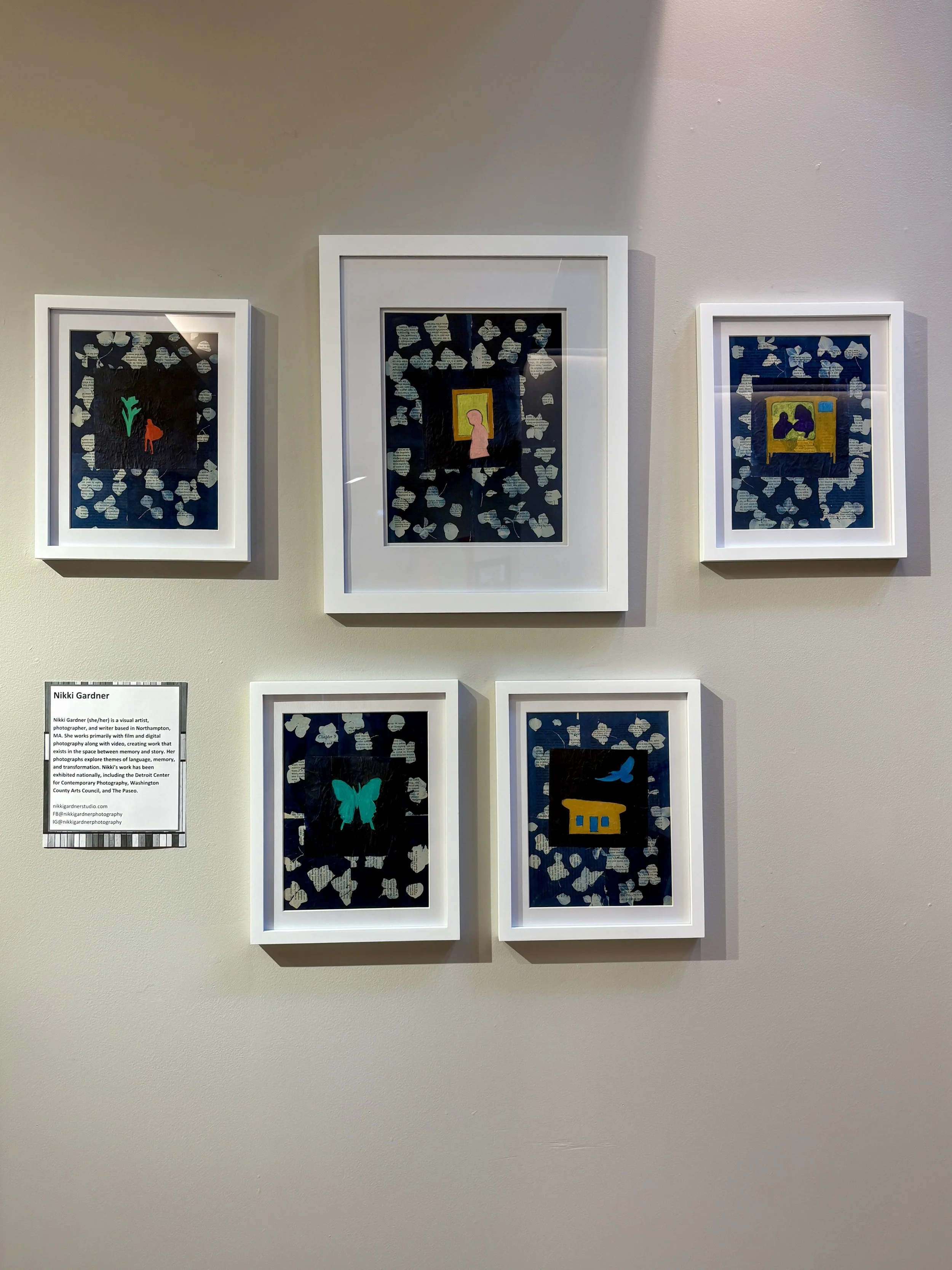
Back in April, I was preparing pieces for the What Was Held series, shown at the Revelry 33 exhibit and the Northampton Center for the Arts. My original plan included more photographic work. But when I started coating the cyanotype paper, something shifted. The photograms I had been working on years earlier pulled my attention back in.
I wanted to push those earlier ideas further. Layered photograms with hand-cut stencils placed over dried flower backgrounds printed on cyanotype, then layered again with a window element that highlighted the stenciled subject, then painted with gouache. I wanted to reference the photographic without including a single photograph in the frame.
It was not what I had planned. And it became exactly what the work needed.
Standing back at the Revelry show, seeing the pieces hung, I saw them differently than I had while making them. More objectively. With a clearer sense of where the work could go next. That distance taught me something about what it means to trust the process even when the process surprises you.
The Good Student vs. the Creative Explorer
Making art is complicated because two versions of yourself are often in the room. There is the good student who wants to do it correctly, follow the framework, earn the approval. And there is the creative explorer who knows it is okay to try things and fail, and equally okay to try things and succeed.
Both are real. Both show up. The work, though, tends to open up when the explorer is leading.
I have a mentor who always says there is no right way to make art. Every time I return to that idea, something loosens. The academic pursuit of doing it right starts to quiet down, and what replaces it feels expansive. Like there is more room to actually make something.
That permission matters. Not just in the studio, but in front of the camera too.
What Portrait Work and Art Have in Common
Portrait sessions carry a version of this same tension. My clients often arrive apologizing. They say they do not know how to move their body, or where to put their hands, or whether to smile with teeth or without. They have worries about how they appear to others and to themselves.
I understand that feeling completely. It is the same instinct that makes an artist second-guess a mark on the page.
What matters to me in a portrait session is not what is on the surface. It is the quality of a person. What it feels like to be in their presence. And capturing that requires something deeper than posing or technique.
What I focus on instead:
Having a real conversation, not running through a checklist
Being present enough to get out of my own way
Connecting with the person so that we can both let go of the pressure to perform
Trusting my instinct the same way I trust it when I am making art
Great portraits are not about doing it perfectly. They come from within. They are about being confident in who you are and feeling genuinely seen by the person holding the camera.
Why Vulnerability Is the Point
Both art and portraiture require trust. Trust that I am present enough in the moment to connect with what is actually happening. Trust that the person in front of me can feel that presence and relax into it. And trust, on both sides, that there is no perfect version of this we are trying to reach.
The only right way to show up is as yourself, without apology.
When I look at the work from the What Was Held series, or when I look at a portrait session that went somewhere unexpected and true, what I value most is not technical precision. It is the evidence that someone was willing to be seen. That is where the real image lives.
Ready to Be Seen?
If you have been putting off a portrait session because you are worried about not knowing what to do or not looking the way you want, I want you to know that those concerns make complete sense, and they are also not the point.
My job is to hold the space so that you can forget about doing it right. So that what comes through is actually you.
If that sounds like what you have been looking for, I would love to connect. You can learn more about working together at nikkigardnerstudio.com.
The work, and the portrait, begins the moment you decide to show up.
